
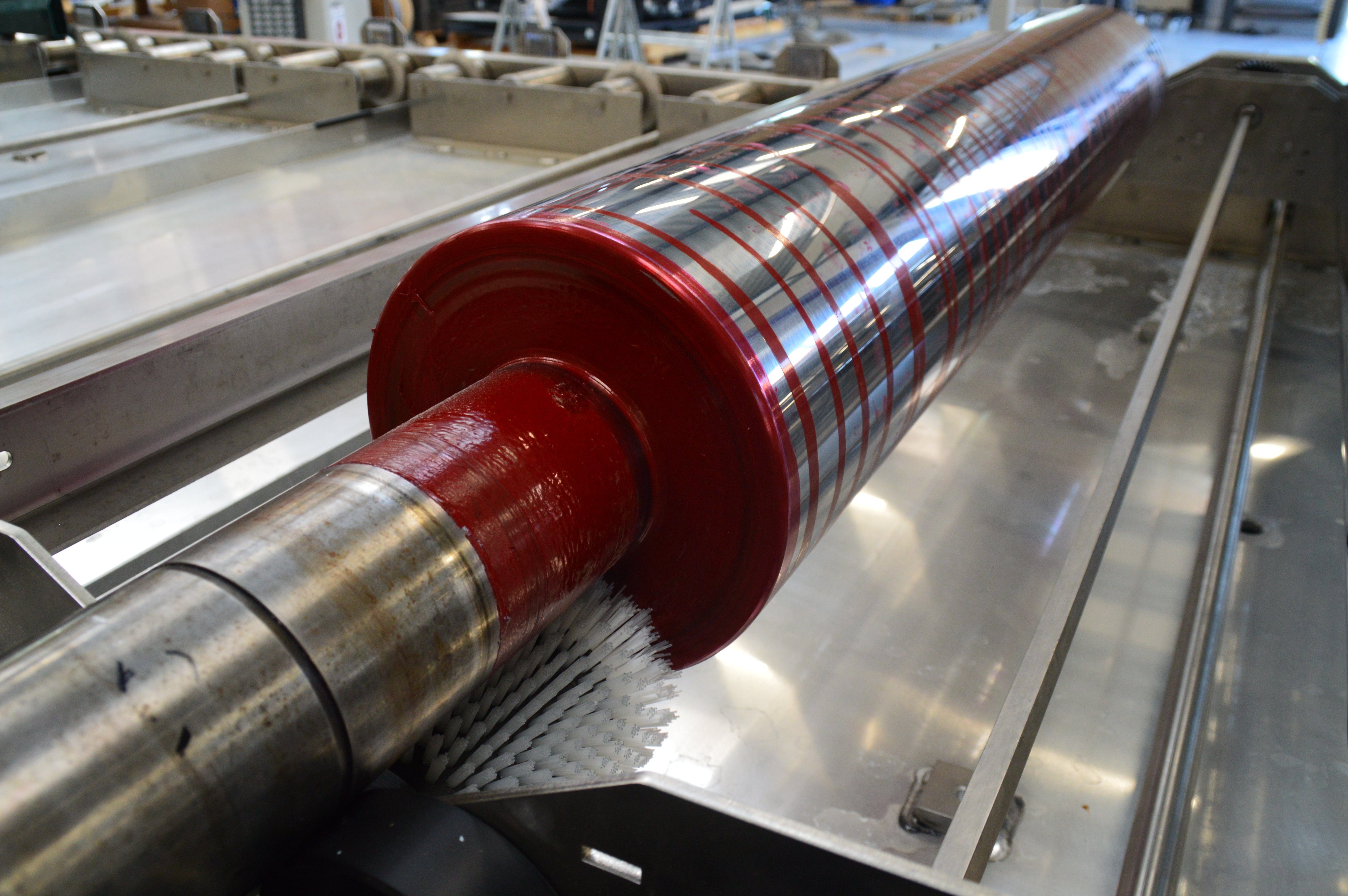
It is a familiar scene in most rotogravure press rooms, and it is worth looking at closely, because a surprising number of production problems start right there. Colour that drifts across a run. Rework on jobs that should have been right the first time. Changeovers that take longer than planned. Skilled operators spending their shift scrubbing instead of setting up. Cylinders and press parts wearing out sooner than they should. Solvent in the air around the washroom.
They look like separate problems. Several of them have the same starting point: how parts and cylinders are cleaned between jobs.
One Person at a Sink, and the Rest Waiting
Cleaning often sits outside the production plan rather than in it, without a set time or a written standard. Putting it into the plan is a small change, but it has three effects.
- The first is that it gets a defined time. That means it can be scheduled and planned around, rather than estimated each time.
- The second is that it gets a defined cleaning standard, so the result is the same whoever carries it out.
- The third is the one that matters most, and it is easy to overlook. Cleaning can run alongside the rest of the changeover instead of holding it up. With manual cleaning, someone stands at the sink, and for as long as they are there, they are not preparing anything else. With an automatic cycle, the machine handles the cleaning, which frees that person to work on the next job at the same time.
What happens when cleaning does not get that place in the plan, is what follows:
Blocked Cells, Dirty Parts and What Both Do to the Print
Quality is where the cost is easiest to see, and in rotogravure it starts with the cylinder. When the engraved cells are partly blocked with dried ink, they transfer less ink, and rarely evenly. On press that shows as colour variation, weak shadow detail, or density that will not hold. Blocked cells are also hard to spot with the naked eye, so the problem is often found late.
Press parts affect the print in the same way. Dried ink left in a tray or a bucket ends up in the next job.
That is the argument for a set standard. An automatic cycle gives the same result each time, regardless of who loaded the machine, so it becomes possible to say what clean means and check against it.
There is a second cost to leaving ink to dry, and it lands on the equipment itself. A cylinder that sits with ink dried into its cells takes harder work to clean, and harder cleaning risks scoring the chrome or wearing the cell walls. That shortens how many times the cylinder can be re-chromed and re-engraved before it is no longer worth recovering. The same goes for press parts: ink left to dry has to be worked off with more force, which can increase the risk of damaging the parts.
How Cleaning Eats Into Changeover Time
Those quality problems cost time to fix. But cleaning takes time before that too, and it is harder to see.
Rotogravure changeovers are rarely quick. Cylinders are heavy and precise, and there is a set of press parts to clean alongside them. What makes that time hard to account for is how it gets recorded - as part of "changeover" as a single figure. Afterwards nobody can say how much was cleaning, how much was waiting, and how much was unavoidable.
The right equipment depends on what you are cleaning and how much of it. For cylinders, up to around 60 a day, a single- or double-cylinder cleaner is usually enough. Above that, a multi cylinder cleaner works as a continuous line, where cylinders are loaded at one end and come out clean at the other.
For press parts, a parts washer takes ink trays, buckets and other removable parts in one unit. Trolleys with slide-in grids move them straight from the press to the washer, which cuts out the carrying and the double handling.
The printing trolley stations themselves are among the hardest things in the press room to clean by hand, and they are usually left to a manual scrub. A trolley wash takes the whole station: parts and cylinders are pushed straight into the machine, and the wash times etc. are set on the unit. That removes one of the dirtiest manual jobs on the floor and makes it repeatable.
Where the equipment sits matters too. Wash stations placed close to the press reduce the walking and transport involved in every changeover.
What Manual Cleaning Costs in Skilled Operator Hours
Time is one cost. Whose time it is, is another.
Many parts of the world are short of skilled rotogravure operators. Every changeover spent scrubbing cylinders or trays is time not spent on registration, colour matching or troubleshooting. This is not about cutting headcount - most press rooms have nobody spare. It is about where scarce hours go, and about how much of the operation depends on a few experienced people.
That dependence has a second side to it. Manual cleaning varies by person, so if a cylinder or a tray often needs cleaning twice, it usually means "clean" was never properly defined. An automatic cycle removes that variation, and it makes training of operators faster, because the method is set by the machine rather than learned from someone.
Solvent Exposure and Physical Strain
Where solvents are used for cleaning, much of the exposure comes from one task: hand-cleaning parts and cylinders in an open workspace, several times per shift.
Enclosed cleaning moves that contact out of the open workspace. It also removes repetitive physical work, which matters in roles that are already hard to staff, and trolleys and slide-in grids take out some of the lifting as well.
There are liquid options that reduce it further. Flexo Wash supplies both low-VOC and VOC-free liquids, and solvent-free options are available. A non-solvent system can also be placed next to the press without the cost and space of an ATEX room. But which way of cleaning is the right one, depends on the company itself.
Where to start
Cleaning turns up in more places than the schedule suggests:
- It affects what comes off the press.
- How long a changeover takes.
- What your skilled operators spend their shift doing.
- How long cylinders and parts last, and what the people doing it are exposed to chemical wise.
It can seem confusing where to start, but the useful first step costs nothing. Spend a shift on the floor, and every time the press stops, write down why in one word. Then put some numbers on your own cleaning: how long a cylinder takes by hand in your washroom, how long a full set of press parts takes, and how many changeovers you run in a week.
That gives you a figure for your own operation rather than an industry average. It is the number worth having before deciding what to change.
In Summary
Several of the problems in this article come back to the same thing: cleaning happens, but it is not planned. It has no set time and no set cleaning standard, and it often holds up the rest of the changeover while someone stands at the sink.
Treating it as a planned step changes that. Automatic equipment, matched to the number of cylinders and press parts you clean, gives cleaning a set time and the same result whoever is on shift. It runs while operators prepare the next job, it moves hand-cleaning out of the open workspace, and regular cleaning stops dried ink from building up on cylinders and parts.
Flexo Wash builds cleaning systems for both rotogravure cylinders and press parts, along with the liquids that go in them. Get in touch to talk through what would fit your volume and your workflow.